Arrows Out
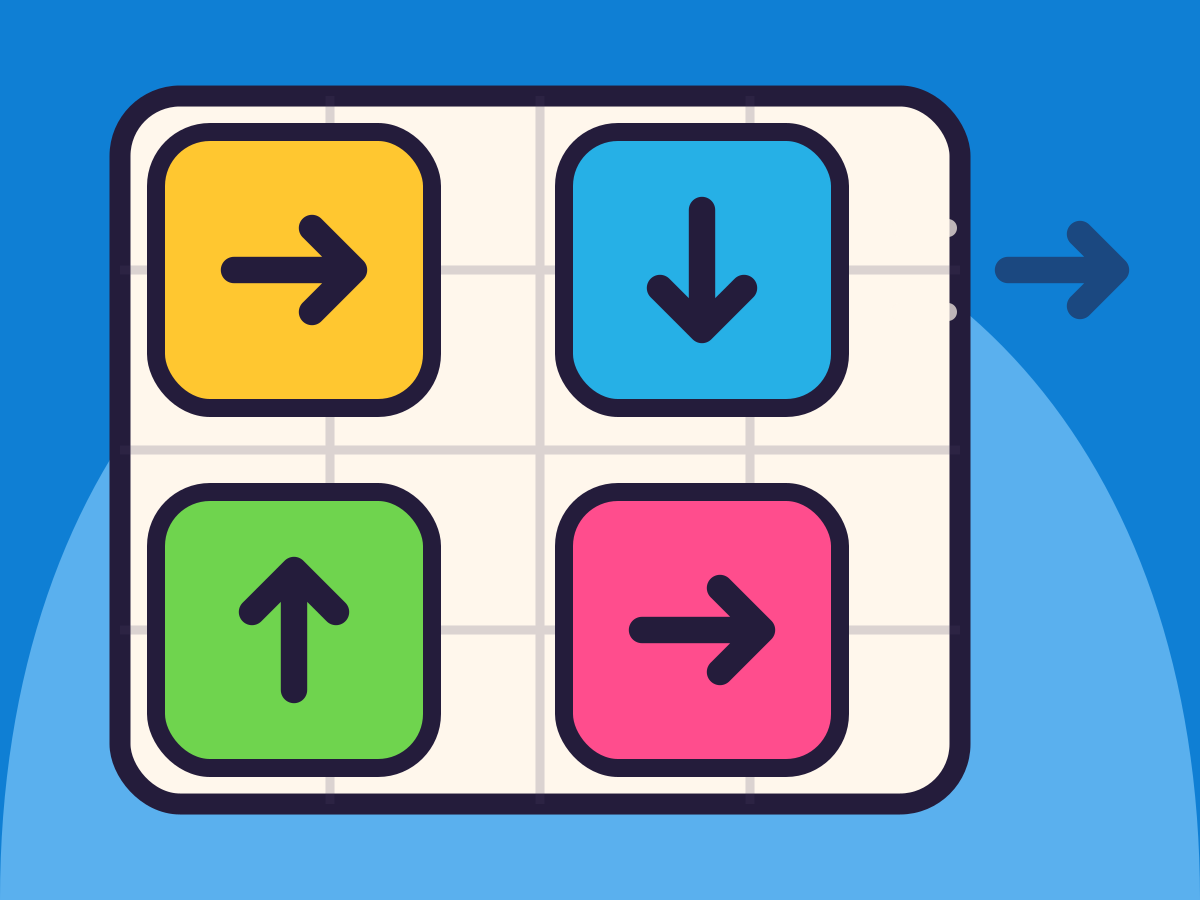
A grid full of arrows, each pointing one of four ways. Tap one whose lane to the edge is clear and it flies off the board. Clear the grid. The record is the time, and quicker wins.
- Free
- No ads
- No account
- No download
- Works offline
- Single player
How do you play?
- Read the point - Every arrow shows which edge it will leave by. The shape carries the direction and the colour only groups them.
- Tap a clear lane - If every square between the arrow and its edge is empty, it goes. If not, it shakes and nothing moves.
- Start at the rim - An arrow already sitting on the edge it points at has nothing in front of it at all, so it can always leave.
- Empty the grid - The round ends when no arrow is left, and the clock stops on that tap.
About this game
Tap an arrow and it flies off the way it points. One condition. Every square between it and the edge has to be empty. That is the whole rule.
What separates the three levels is not the size of the grid, it is how much of the grid is stuck. Across 4,000 dealt boards per level, an easy board opens with 5.7 of its 8 arrows already free to go, a medium one with 8.8 of 14, and a hard one with 12.5 of 22. So a little over half of a hard board can move on the first tap and the rest is waiting for somebody to clear a lane. The spread between two hard boards is wide, from 7 free arrows up to 18, and that draw decides more about how a game feels than the difficulty label does.
You cannot trap yourself, and that comes out of the rules rather than out of luck. A tap only empties a square, an empty square blocks nothing, so a lane that was clear stays clear. We checked the blunt way. A bot tapping completely at random, with no thought behind any choice, finished 12,000 boards out of 12,000. None of them jammed.
The count does not move either. A hard board ends on tap 22, every time.
Here is the catch. Nothing can be lost, so the only thing left worth measuring is the clock, and the clock keeps running while you sit and think. A child who likes to plan gets no credit for it here. Anyone hunting a puzzle with teeth will clear hard and want more. Fast eyes win this one.
What does it teach?
Reading a direction
Saying where a shape points and following its line to the edge is a spatial skill nurseries practise with hands and hoops. Here it is the whole game.
Seeing the obstacle
The question is never the arrow, it is what stands in front of it. A child learns quickly to look at the path instead of the object.
Scanning quickly
Finding one of the 12.5 free arrows on a hard board of 22 is a visual attention exercise, and the clock puts a number on it.
Tips
Do not think, tap
No order spoils a board, so hesitation is the only thing that costs you anything. Take the first free arrow your eye lands on.
One direction at a time
Chase every arrow of one colour before you switch. Your eye sweeps a single line instead of raking the whole grid, and the time drops.
Peel from the outside
The rim empties fast and each departure opens the middle. The board never closes back up, it only opens.
A refusal is free
A blocked arrow costs nothing and counts nothing. When you are unsure, tap to find out instead of counting squares with your eyes.
What age is it for?
4 to 5
Easy, 8 arrows on a 4 by 4 grid. Nearly three arrows in every four can move from the start, so a first tap almost always works.
6 to 8
Medium, 14 arrows, where following a line with your eyes before tapping starts to pay.
9 and up
Hard, 22 arrows on a 6 by 6 grid. The whole board fits on the screen and the clock becomes the real opponent.
Grown-ups
A hard board is a break of a few dozen seconds. The record is kept per level, so there are three marks to beat rather than one.
Accessibility
One tap per action, with no dragging and no press-and-hold, so it works with alternative input devices and with a small hand that does not aim well yet. Every square is a button you can reach from the keyboard, labelled with its row, its column and the direction of the arrow on it. The shape carries the information and the colour only groups, and the four hues are spread apart in lightness so they stay distinct without relying on colour vision. On a 390 pixel phone a square of the largest grid measures about 57 pixels. A blocked arrow answers with a shake rather than an error sound.
Playing together
One tap each
Take turns on the same board. Neither player can spoil the other's game, which makes waiting for a turn bearable.
Call it first
Say out loud which edge the arrow will leave by before tapping. A child who gets that right has understood the entire rule.
The colour race
One player takes only the arrows of a single colour and the other takes the rest. The board empties twice as fast and the argument is over the shared squares.
Two devices, one clock
Same level, start together, compare times. The boards differ, so swap places for the second round.
Common questions
Can you get stuck with no move left?
No. Out of 12,000 boards played entirely at random, not one jammed. A tap empties a square and an empty square blocks nothing, so clear lanes stay clear.
How many arrows are there per level?
8 on a 4 by 4 grid, 14 on a 5 by 5, and 22 on a 6 by 6.
Does the order of taps matter?
For finishing, no. For the clock, yes. A hard board takes exactly 22 taps whichever route you pick, so only the searching time changes.
How is the record measured?
In time, where quicker is better, and separately for each level. A board of 8 arrows and a board of 22 are not the same achievement.
What happens if I tap a blocked arrow?
It shakes, and that is all. The tap is not counted and no message appears, because a reasonable guess does not deserve a telling-off.
Do you need to read to play?
No. There is not one letter or digit on the board, so a child who cannot read plays alone.
Is it free?
Completely, with no ads and no account. After one visit it runs with no signal at all.
Is a half-finished board kept?
Yes. The grid and the clock are stored on the device, so putting the tablet down costs nothing.
More games
- Picture LogicThinking
- One StrokeThinking
- UntangleThinking
- Puzzle SnakeThinking
- What Comes NextThinking
- What DisappearedThinking
- Falling BlocksClassics
- Word GuessLearning
- Pop the BalloonsFor kids
Put this game on your site
Copy the code and paste it into your page. The line under the frame is the part that counts: a link inside the frame stays on ellaz.fun, and only the one you paste is yours.
Play Arrows Out and more free games at ellaz.fun
<iframe src="https://ellaz.fun/embed/arrowtap/?lang=en" width="100%" height="940" style="border:0;border-radius:12px" allow="fullscreen" title="Arrows Out - ellaz.fun"></iframe>
<p>Play <a href="https://ellaz.fun/games/arrowtap/">Arrows Out</a> and more free games at <a href="https://ellaz.fun/">ellaz.fun</a></p>